A new industry survey of 244 real estate agents just confirmed something most sellers suspect but rarely hear said out loud: the person pricing your home is under pressure to move fast, and knows, deep down, that moving fast and getting it right are often two different things.
Here's the gap. In the survey, 84% of agents said responding quickly when a seller asks about pricing is extremely or very important. Only 7% said they typically deliver that pricing guidance within an hour. Roughly a quarter said slow response time has possibly or definitely cost them a listing outright.
So agents feel the pressure. They just can't outrun it, because the thing that actually takes time isn't math. It's judgment. The survey found that finding the right comparable properties is, by a wide margin, the most time-consuming part of building a pricing analysis, followed closely by adjusting for the differences between your home and everyone else's. Building a defensible number, it turns out, requires real thought. Fast and thoughtful don't always fit in the same hour.
That's a useful thing to know as a seller. But it's not actually the question you should be asking.
Fast Has a Cost. So Does Wrong.
It's tempting to read the survey and conclude that speed is the fix: that the agent who gets you a number in twenty minutes is doing you a favor. Sometimes that's true. A seller with a hard deadline genuinely needs a fast answer.
But speed and accuracy are both answering the same question, "what is my home worth?" They're just doing it at different velocities. And that's the question worth stepping back from entirely.
Because here's the thing almost nobody says plainly: your home doesn't have one true number sitting on paper, waiting for someone fast enough or careful enough to find it.
"Market Value" Isn't Something an Agent Calculates. It's Something Buyers Decide.
This is where the language we all use gets sloppy, and where sellers get quietly misled, even by well-meaning agents.
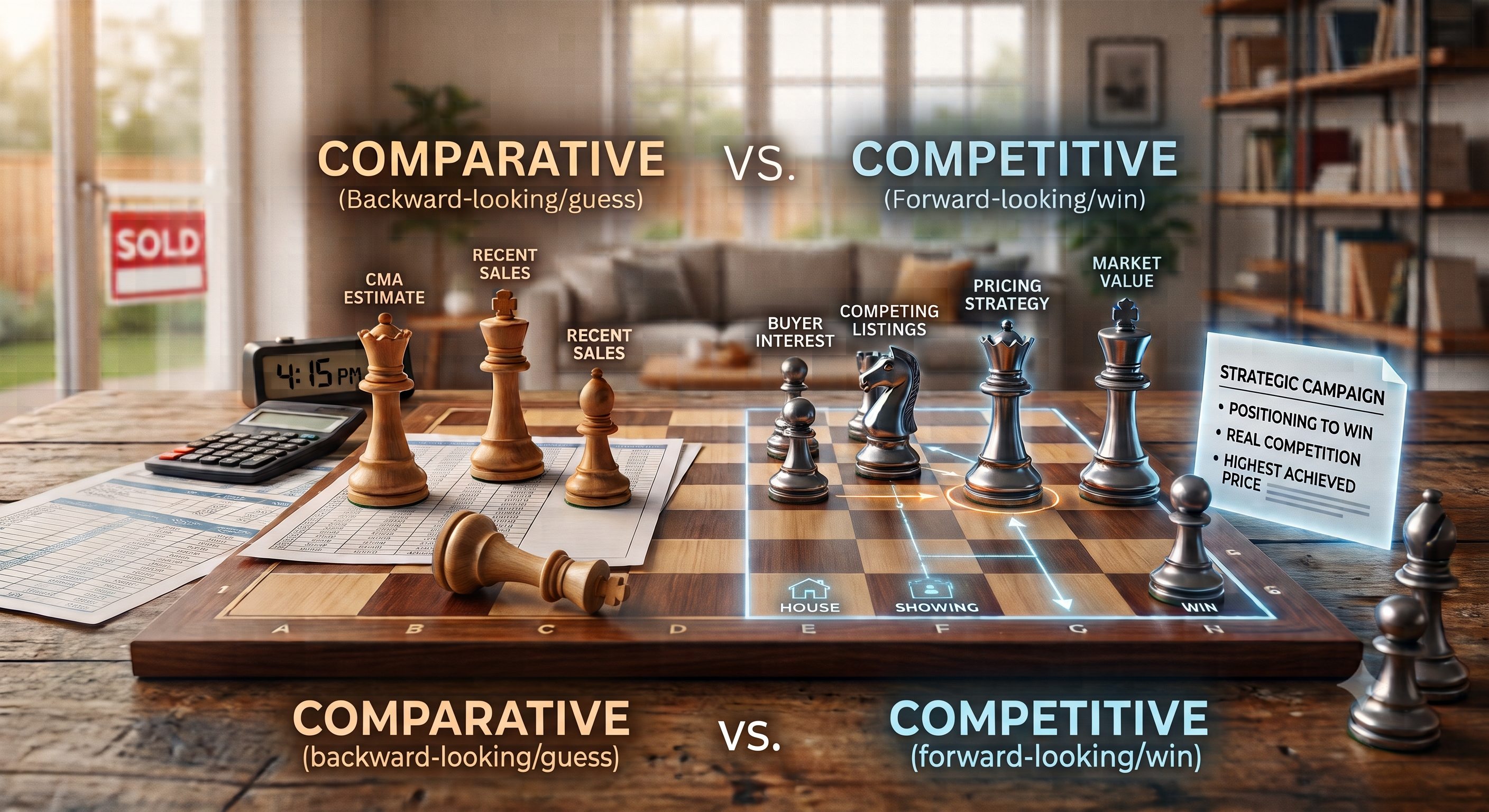
A traditional Comparative Market Analysis pulls recent sales of similar homes, adjusts for differences, and lands on a number. Agents call that number "market value." It isn't. Not yet.
True market value only exists once real buyers, with real motivations, are actually competing (or not) for your specific home. Supply and demand set the price. Each buyer's urgency, budget, and emotional pull toward the property set the price. No agent sitting at a desk with a spreadsheet of past sales can calculate that in advance, because it hasn't happened yet.
What a paper-based analysis actually produces is an estimated value: an informed, professional guess about where similar homes have landed. Useful. Necessary. But still a guess about the past, not a measurement of what buyers will pay for your home, right now, in this market.
That distinction isn't semantic. It changes what the pricing conversation is even for.
Comparative Asks the Wrong Question. Competitive Asks the Right One.
A Comparative Market Analysis asks a backward-looking question: what have similar homes sold for?
At HeartLink Homes, we don't build a Comparative Market Analysis. We build a Competitive Market Analysis, and the difference isn't just the label. It's the entire goal of the exercise.
A Competitive Market Analysis asks a forward-looking, strategic question: how does this home need to be positioned, right now, to win against everything buyers are choosing between today?
What This Means for You
The goal isn't to land on "the" value of your home. It's to land on a starting list price that launches a strategic selling process, one built to generate real competitive tension in the market.
That distinction plays out in a very concrete way: more eyeballs on the home leads to more showings, more showings lead to more offers, and more offers create the competitive pressure that pushes toward a higher achieved price. That's a pricing strategy decision, grounded in how buyers behave, not a valuation output pulled from a spreadsheet of closed sales. Depending on your market and your goals, it can point to a genuinely different starting number than a standard CMA would.
Neither approach is dishonest. But only one of them is designed to find out what the market actually thinks your home is worth, because only one of them is built to expose your home to the market in a way that lets buyers answer that question themselves.
What If We're Asking the Wrong Question?
Instead of asking:
"How quickly can you tell me what my home is worth?"
We think sellers should ask:
"How are you going to position my home so that we know we're getting the true and full market value our home can achieve?"
Those are two very different questions. The first one can be answered in an hour, or a day, or a week, and the number you get back is still just an educated guess, dressed up as a fact. The second one can only be answered by an agent who's thinking about your listing as a campaign, not a calculation.
What to Actually Ask an Agent
If you're interviewing agents to sell your home, the speed of their response matters far less than the substance behind it. A few questions worth asking directly:
Estimate or Strategy?
Ask them to explain the difference between an estimate and a pricing strategy in their own words. If they can't, that's information.
What's the Early Signal?
How will we know if we've priced too high and are losing buyer interest? A good agent has a plan for tracking early showing activity and buyer feedback, not just a number they're hoping holds up.
What's the Adjustment Plan?
What's the plan if the first two weeks don't generate the activity we expect? Pricing strategy isn't "set it and forget it." It should include a defined response to how the market actually reacts.
An agent who can answer those clearly is thinking about your home the way a buyer eventually will: as something to compete for, not a line item to be estimated.
The Bottom Line
Your home's value isn't something to be found on paper, fast or otherwise. It's something the market reveals, once real buyers engage with it. A Competitive Market Analysis isn't about being faster or even more accurate than the next agent's spreadsheet. It's about setting up the conditions, the price, the positioning, the presentation, that let the market show you the best version of what your home is worth.
That's not a number we hand you in an hour. It's a strategy we build with you, before the sign ever goes in the yard.
Curious What This Looks Like for Your Home?
At HeartLink Homes, we don't just hand you a number, we build a strategy with you, grounded in how buyers actually behave in today's market.
Let's talk through it in a seller consultation. No pressure, just a clear look at how we'd position your home to compete.
Call us at (206) 999-0510
Or email info@heartlinkhomes.com, or visit us at heartlinkhomes.com.
